
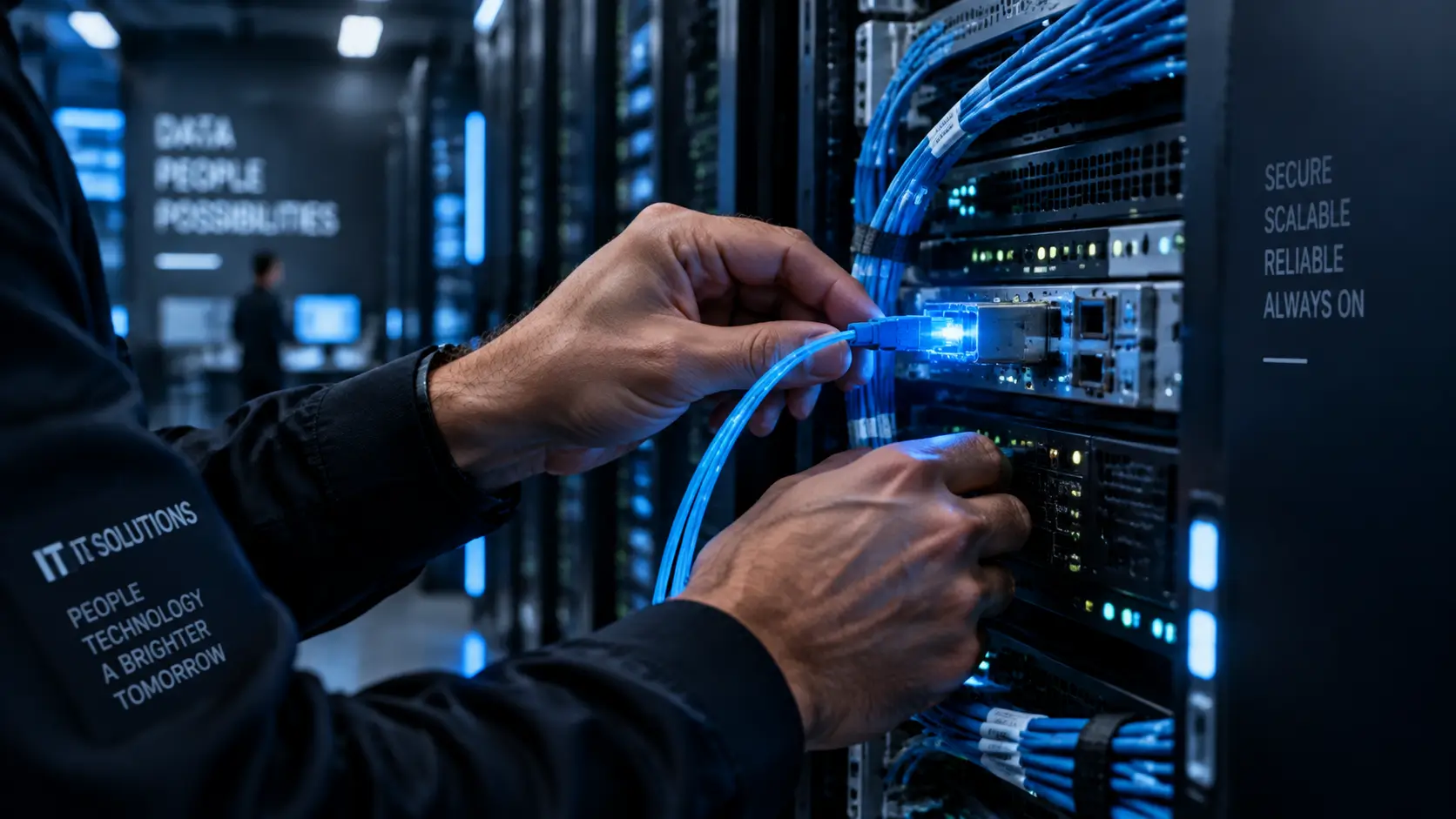
Having servers, network devices, or critical infrastructure hosted in a Data Center offers undeniable strategic advantages for any company, such as higher availability, high physical security standards, electrical redundancy, and high-speed connectivity.
Even so, this distributed operational model also presents a constant operational challenge that can arise at the least expected moment, especially when there is a need to physically intervene with the equipment and the in-house technical staff is not on-site. In these cases, having someone who can handle these situations in a timely manner becomes essential.
A critical alert in the monitoring system, a network or fiber cable that requires inspection, a degraded hard drive that must be replaced immediately, or the need to perform a hard reboot can quickly become an operational bottleneck when there is no trained personnel near the facilities. In high-demand situations, physical distance translates directly into extended downtime and a loss of business continuity.
At Itnetwide, we perfectly understand this dynamic. We know that modern technological architecture is designed to operate centrally and remotely, while engineering and IT teams often work from corporate offices or distributed setups many miles away from the Data Center.
It is precisely in this scenario where the Remote Hands service becomes a fundamental extension for infrastructure management. In this article, we explain in detail what this service entails, what kind of technical tasks it can cover on a day-to-day basis, and why having qualified on-site technical assistance simplifies administration, protects operability, and optimizes your organization’s resources.
What is Remote Hands?
Remote Hands is an on-site technical assistance service for companies that have technological infrastructure located in a Data Center and need a technician to perform specific physical tasks on location.
The company maintains control of its equipment and technical decisions, while the Remote Hands staff executes the physical activities that have been requested and authorized. In simple terms, it functions as a physical extension of the company’s technical team.
This is especially useful when IT managers can diagnose a situation remotely but need someone physically in front of the server, rack, or equipment to execute an action.
How Does a Remote Hands Service Work?
The process begins when the company identifies a task that requires a physical presence in the Data Center. The responsible team provides the corresponding instructions, and the on-site technician performs the requested intervention. Depending on the procedure, they may verify equipment status, check connections, install hardware, or execute other previously defined activities.
Communication between both parties is essential; instructions must be clear, and the technician must report what was done so the remote team can continue with the process.
At Itnetwide, we know that this coordination is an essential part of the service. On-site assistance must be integrated with the company’s technical procedures and not become an isolated action.
What Tasks Can a Remote Hands Technician Perform?
Activities depend on each company’s needs, the type of infrastructure, and the procedures authorized by the client and the Data Center. Tasks that may require on-site assistance include:
Hardware Installation
When a company acquires new equipment for its infrastructure, it may need someone to physically install it inside the rack. The technician can support activities related to the placement of the equipment and its connections, following the instructions provided by the technical lead.
Equipment Inspection
An incident may require a physical inspection. In these cases, the technician can check indicators, connections, or the visible status of the hardware and transmit the information to the team in charge. This review allows obtaining data that cannot always be acquired through remote management tools.
Cable Connection and Disconnection
An incorrect physical connection can affect communication between different components. Remote Hands can support connecting, disconnecting, or verifying cables following specific instructions, especially when the responsible team is in another location.
Component Replacement
Some interventions require removing a component and installing a new one. When the procedure is defined and the staff has the corresponding authorization, an on-site technician can execute this task. The ability to perform these actions without waiting for an internal team member to travel can speed up certain interventions.
When Does a Company Need a Remote Hands Service?
Not all organizations need constant on-site assistance. In many cases, the service becomes important when there is geographically distributed infrastructure.
A company may have its IT department in one city and its servers in another; likewise, it may operate with infrastructure hosted in different Data Centers. In these situations, sending your own personnel every time an intervention is needed can involve travel time, coordination, and associated expenses; Remote Hands offers an alternative for specific tasks that require a physical presence.
When infrastructure is in another location
This is one of the clearest scenarios. If our equipment is far from the staff managing it, we need a practical way to perform on-site interventions.
When a local response is required
An incident may appear outside the internal team’s regular hours or at a time when traveling to the Data Center is not convenient. Having local support allows evaluating the situation physically and executing authorized actions.
When carrying out installations or expansions
Growth projects may require installing new servers, network equipment, or components within a Data Center. In these cases, having on-site technical personnel can facilitate certain stages of the project.
What Advantages Does Remote Hands Offer for a Company?
The main benefit is the ability to have on-site technical assistance without permanently keeping an in-house team at each location. This can be especially useful for companies managing distributed infrastructure.
Reduces the need for travel
When a local technician can execute an intervention, the internal team can avoid a trip dedicated exclusively to performing a physical task. This way, the time of the specialists responsible for the infrastructure can be better utilized.
Facilitates incident response
Some situations require physically checking what is happening. Having a person available at the Data Center allows obtaining information and performing actions following the defined procedure.
Supports infrastructure projects
Installing new equipment requires coordination and precision. Remote Hands can become an additional resource during certain implementation phases.
Complements remote management
Remote Hands does not necessarily replace a company’s technical team. Its function can be complementary; while specialists manage systems, networks, or servers remotely, the on-site technician can handle the physical tasks that require being there in person.
Does Remote Hands Replace the Internal IT Team?
Not necessarily; in fact, one of the main values of the service is complementing existing capabilities.
The internal team continues to make decisions, diagnose problems, and define necessary actions. The on-site technician executes those activities that require physical contact with the infrastructure.
This division can be practical for companies with specialized teams working remotely. At Itnetwide, we view Remote Hands as an extension of our clients’ technical capabilities, adapted to the needs of each intervention.
Why is Remote Hands Important for Modern Technological Infrastructure?
Companies work with increasingly distributed infrastructures. Their applications, servers, and services can be in different locations, while the teams responsible for managing them work from other cities or even other countries.
This reality makes the ability to physically intervene remotely practically valuable. Remote Hands connects both scenarios by combining the expertise of the technical team managing the infrastructure with the presence of a person capable of physically intervening in the Data Center.
How Does Itnetwide Offer Remote Hands Services?
At Itnetwide, we help companies that need on-site technical support for their infrastructure located in Data Centers. Our service can support tasks related to hardware installation, equipment inspection, connections, component replacement, and other previously coordinated physical interventions.
We work to ensure each activity responds to the specific instructions and needs of our clients. We understand that an intervention in a Data Center requires precision, communication, and follow-up.
Our goal is to become a technical ally for companies that need to keep their infrastructure operational regardless of where it is physically located.
Request Remote Hands Support with Itnetwide
If your company keeps servers, hardware, or technological infrastructure in a Data Center and needs on-site assistance to perform physical interventions, Itnetwide can become your technical ally on-site.
Our Remote Hands service is designed to complement the work of your IT teams and facilitate tasks that require physical presence. Contact us to learn how we can support the operation and maintenance of your Data Center infrastructure.
Frequently Asked Questions
What does Remote Hands mean?
Remote Hands is an on-site technical assistance service that allows a company to have personnel in a Data Center to perform specific physical tasks on its equipment and infrastructure.
What tasks can Remote Hands perform?
Depending on the agreed scope, it can include hardware installation, equipment inspection, cable connection, component replacement, and other physical activities requested by the client.
Is Remote Hands useful if my IT team works remotely?
Yes. Indeed, one of its main uses is complementing the remote team when a task requires a person to be physically in the Data Center.
Does Itnetwide offer Remote Hands support?
Yes. At Itnetwide, we offer Remote Hands services for companies that need on-site technical assistance for infrastructure located in Data Centers.
