
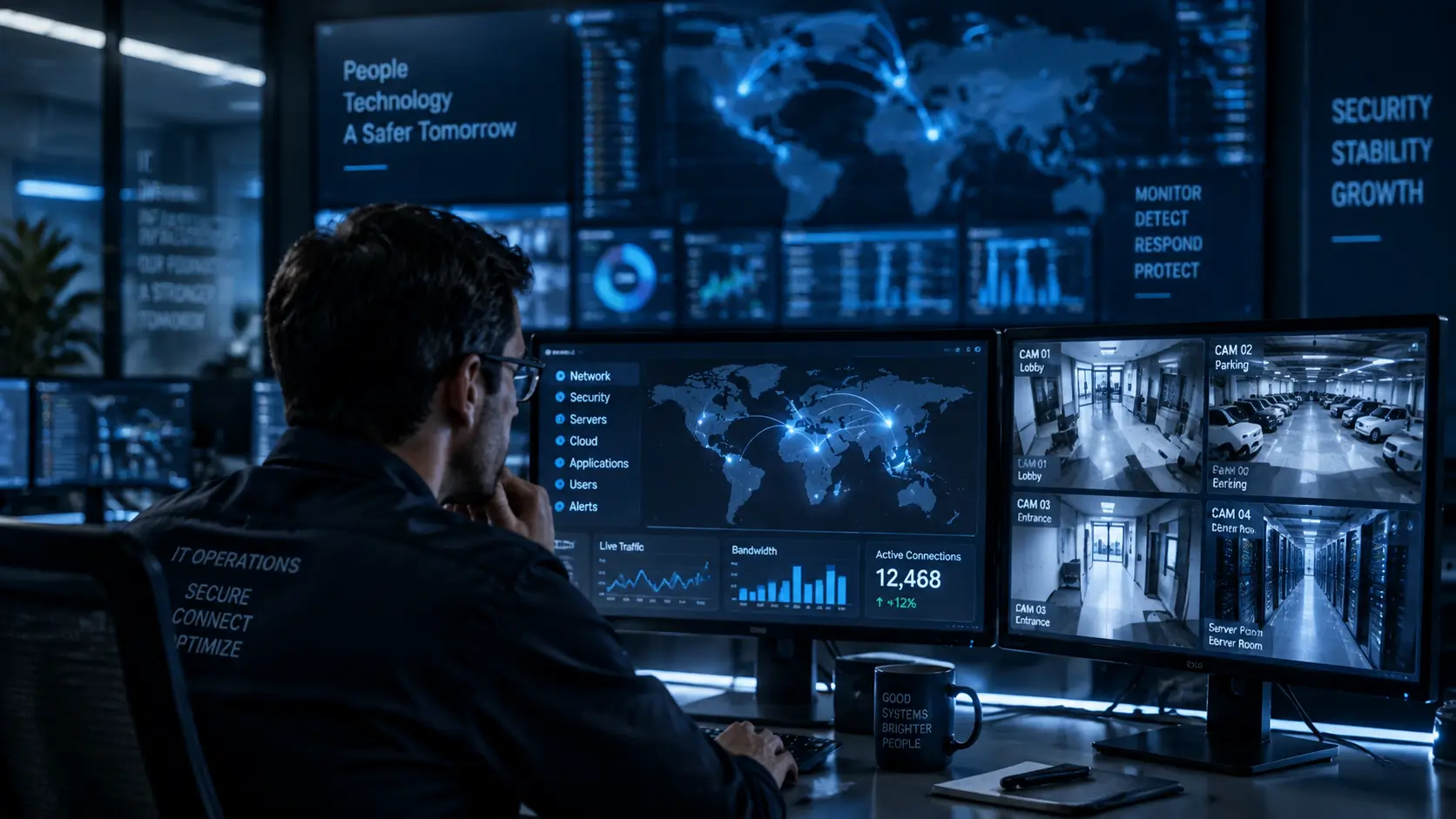
Protecting a company’s facilities requires a comprehensive monitoring and control strategy, beyond just cameras distributed in strategic locations. Corporate spaces house equipment, information, restricted areas, and resources that require proper protection and surveillance mechanisms. Security technologies have evolved, allowing different solutions to be integrated within the same infrastructure.
IP cameras, video surveillance systems, and access control can be connected through enterprise networks to facilitate the management and supervision of spaces. When these systems are implemented independently, there can be difficulties in managing them, expanding their coverage, or relating them to other technological components. A well-planned infrastructure allows for a more organized connection between the different elements.
At Itnetwide, we view enterprise security as a strategic pillar integrated within the organization’s technological infrastructure, where each element fulfills a function within a coordinated protection strategy. Our approach combines high-performance connectivity, robust networks, and advanced protection systems to create solutions tailored to each project.
In this article, we will explain how IP video surveillance cameras, data networks, and access control systems are integrated, along with the key technical factors to create an efficient, scalable, and future-proof corporate security ecosystem.
How Do Enterprise Security Cameras Work?
Modern cameras can transmit images over IP networks, allowing information to be sent to storage systems, monitoring stations, or other platforms.
An IP camera needs adequate connectivity to transmit images stably. The quality of the installation will depend on various factors, such as the type of camera, location, network infrastructure, and storage needs. This means that installing a camera requires defining both the point we want to observe and how the information will reach the system responsible for managing it.
Where Should Cameras Be Located?
The location depends on the characteristics of each space and the surveillance objective; entrances, circulation areas, storage areas, restricted access points, and strategic locations may require different types of coverage.
Before installing the equipment, it is advisable to identify what we want to monitor and which areas have the greatest need for control. Proper planning avoids indiscriminately installing cameras and allows for more efficient use of available resources.
What Role Does the Network Play in a Video Surveillance System?
The network acts as the medium that allows cameras to communicate with the systems responsible for receiving, storing, or displaying the images.
When there is a large number of devices, the infrastructure must be prepared to handle the traffic generated by these connections. A network with insufficient capacity can affect transmission and cause difficulties during monitoring.
Here again, it is important to have an organized network infrastructure. The cabling, communication equipment, and connectivity must respond to the needs of the security system. At Itnetwide, we can integrate these elements into a technological infrastructure solution designed for the specific conditions of each company.
What Is Access Control and What Is It Used For?
Access control allows you to manage the entry and exit of people in certain spaces. Depending on the project, cards, biometric devices, codes, or other identification mechanisms can be used. The choice depends on the required security level and the characteristics of the location.
This technology is especially useful when a company needs to restrict entry to specific areas. Administrative offices, operations centers, technical rooms, storage areas, or spaces with sensitive equipment may require different access levels.
Why Integrate Access Control with Other Systems?
Integration provides a more complete view of what is happening inside the facilities. For example, cameras can complement the monitoring of entry points, while the access system records specific events. By working on a connected infrastructure, these resources can be part of a more organized security strategy.
What Are the Advantages of Integrating Cameras and Access Control?
The main advantage is having solutions that operate on the same technological infrastructure. This simplifies administration and allows for better planning of future expansions. If the company adds new areas, cameras, or access points, a properly designed infrastructure can provide better conditions for making these changes.
It also facilitates maintenance; when components are organized and correctly identified, it is easier to locate connections, check equipment, and perform technical interventions.
Does Physical Infrastructure Also Influence Security?
Yes. The operation of security systems depends on physical elements that must be installed correctly. Structured cabling and fiber optics can be used to connect different equipment according to the project’s characteristics. Racks help organize certain components, while network equipment facilitates communication between devices.
This relationship shows that technological security cannot be analyzed in isolation; a camera might be of excellent quality, but it needs an infrastructure that allows it to transmit and manage the information it generates.
What Should We Consider Before Installing an Enterprise Security System?
Before implementing any security solution, it is essential to conduct a comprehensive assessment of the existing infrastructure, the physical characteristics of the space, and the specific operational requirements of the organization. A planned design prevents cost overruns, coverage vulnerabilities, and network bottlenecks.
Analyze and Prioritize Critical Areas:
A field survey is necessary to identify entrances, emergency exits, reception areas, storage zones, data centers, and blind spots that require constant supervision or restricted access.
Define Device Density and Type:
The number of IP cameras, sensors, and access control readers will depend on the required level of detail (facial recognition, license plate reading, night vision), the necessary viewing angles, and the lighting conditions of each area.
Evaluate Network Infrastructure Capacity:
A modern security system generates continuous and demanding data traffic. It is vital to check if the network, structured cabling, switches (PoE), and existing bandwidth have the capacity to support the new devices without compromising the speed or stability of other operations.
Project Scalability and Future Growth:
Organizations evolve, reconfigure their spaces, or open new branches. Designing a modular architecture from the beginning allows for the quick and easy integration of new cameras or access points, without the need to redo the base installation.
What Mistakes Should We Avoid in a Security Installation?
One of the main mistakes is installing equipment without prior planning; this can result in areas without coverage or systems that are difficult to manage. Likewise, we must avoid ignoring the network infrastructure. Cameras and access devices depend on adequate connectivity to function properly.
Another important aspect is organization. Unidentified cabling, equipment installed without a clear structure, or a lack of documentation can complicate maintenance and increase the time needed to fix a failure.
Finally, we must avoid designing a solution thinking only about current needs. A company may grow and require new devices, so scalability must be part of the project.
How Do We Handle Enterprise Security at Itnetwide?
At Itnetwide, we integrate enterprise security camera solutions, networks, and access control within technological infrastructure projects. We analyze the space’s conditions and the needs of each organization to define a solution that can integrate with other technological components.
Our approach covers both the equipment installation and the infrastructure that connects it. In this way, we aim to build organized systems prepared for future needs.
A Connected Infrastructure Strengthens Security
Cameras, access control, and networks may fulfill different functions, but they all depend on the same foundation to communicate properly: an adequate technological infrastructure. A well-planned solution facilitates supervision, maintenance, and the expansions that may arise as the company grows.
At Itnetwide, we work so that security technology becomes part of a solid, organized enterprise infrastructure, ready to respond to the needs of every operation.
Protect Your Company with an Integrated Security Infrastructure
If your company needs to install security cameras, implement an access control system, or integrate different solutions within its technological infrastructure, at Itnetwide we can help. We work on designing and implementing solutions that integrate security, connectivity, and networks to respond to the specific conditions of each project.
Contact us to learn about our enterprise security, video surveillance, and access control solutions.
Frequently Asked Questions
What does an enterprise security system include?
It can include security cameras, video surveillance systems, access control, networks, storage, and various technological elements depending on the organization’s needs.
Why do IP cameras need good network infrastructure?
Because they transmit information over the network. A properly sized infrastructure ensures stable communication between the cameras and the systems managing the images.
Can cameras be integrated with access control?
Yes. Both systems can be part of an integrated technological infrastructure, making it easier to manage and monitor different areas.
Does Itnetwide install cameras and access control systems?
Yes. Itnetwide develops enterprise security solutions that can integrate cameras, networks, and access control within a technological infrastructure.
